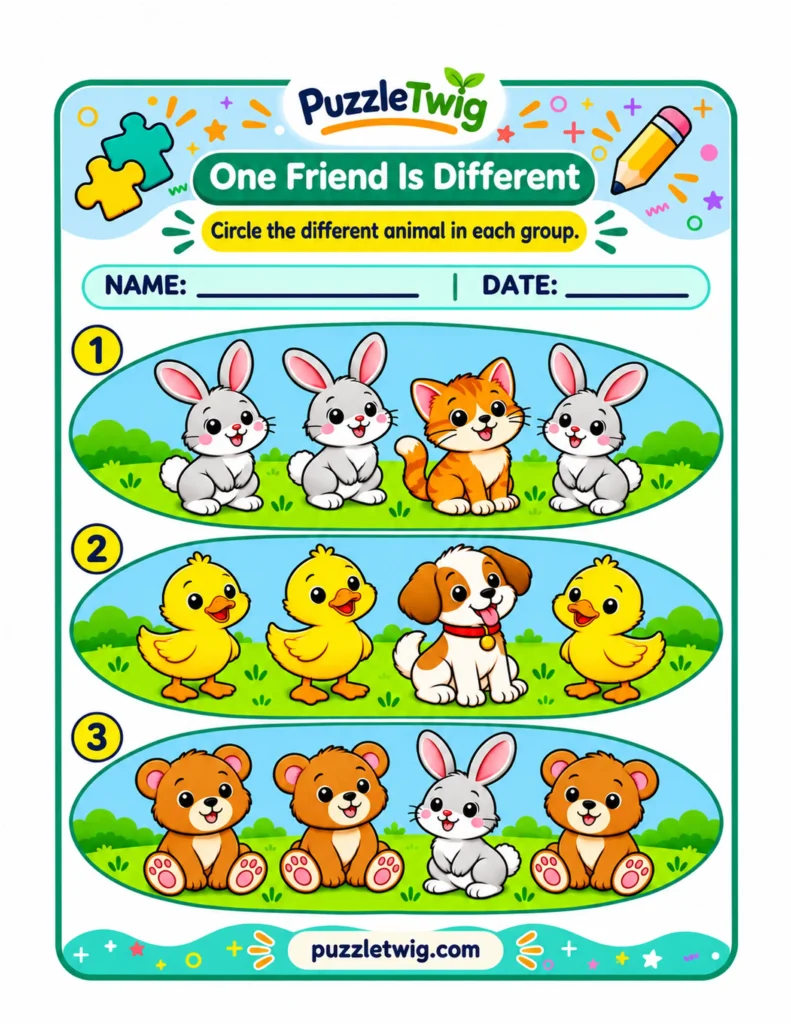
This free animal odd one out worksheet features 3 colorful picture puzzles for preschool children ages 3–6. Each puzzle shows four adorable animals, but one is different from the other three. Children will meet playful rabbits, a kitten, yellow chicks, a puppy, and cuddly bears as they explore these fun visual challenges.
With 3 animal odd one out puzzles on one printable page, this activity encourages young learners to notice similarities and differences. The cheerful illustrations make it a great screen-free learning activity for preschool classrooms, kindergarten readiness practice, or quiet learning time at home.
Free printable activity
One Friend Is Different – 3 Animal Puzzles
Children examine 3 groups of four animals and circle the one animal that is different from the other three in each group.
- Ages 3–6
- Visual discrimination
- Easy
- One-page printable
Materials Needed
- Printed animal odd one out worksheet
- Pencil or crayon
- Flat writing surface
How to Prepare the Activity
Print the one-page worksheet featuring 3 animal picture puzzles. Provide a pencil or crayon and explain that each group contains three matching animals and one different animal.
How to Play — Step by Step
- Write your name and date at the top of the worksheet.
- Look carefully at the four animals in the first group.
- Find the three animals that are the same.
- Circle the one animal that is different.
- Repeat the activity for the second and third groups.
- Review all 3 answers and explain why each selected animal is different.
What Kids Practice
- Visual discrimination
- Sorting and classification
- Attention to detail
- Logical reasoning
- Animal recognition
Make It Easier
Have children name the four animals in each group before searching for the different one. Help them identify two matching animals first, then encourage them to compare the remaining pictures.
Add a Challenge
Ask children to complete all 3 puzzles independently and explain their choices using complete sentences. Encourage them to describe what the three matching animals have in common and why the fourth animal does not belong.
Helpful Tips for Parents & Teachers
Encourage children to compare the animals carefully instead of guessing. Use simple questions such as "Which animals look the same?" and "Which animal does not belong?" to support their reasoning.
Answer Check
If a separate answer key PDF is available, use it to check the 3 correct answers: the cat in group 1, the dog in group 2, and the rabbit in group 3.
Why Animal Odd One Out Activities Help Preschoolers Learn
Animal odd one out activities help preschool children develop visual discrimination, classification, and early reasoning skills. As children examine the 3 picture puzzles, they practice recognizing similarities, noticing differences, and grouping familiar animals by their shared features. These foundational skills support other early learning activities, including sorting, matching, pattern recognition, and identifying shapes.
Finding the different animal also encourages concentration, careful observation, and independent thinking. Children learn to compare visual information and make decisions based on what they see. Explaining why one animal is different provides opportunities to strengthen vocabulary, descriptive language, and confidence in communicating their ideas.
Teacher Tips from the Classroom
- Introduce the Animal Groups. Have children name the animals in all 3 puzzles before beginning. Ask them to identify the rabbits, kitten, chicks, puppy, and bears and talk about what makes each animal recognizable.
- Practice Same and Different. Encourage children to examine the three matching animals in each group. Ask what they have in common before inviting children to circle the different animal.
- Encourage Children to Explain. After completing all 3 puzzles, invite children to explain their answers. Encourage sentences such as “The puppy is different because the other three animals are chicks.”
Extend the Fun
- Toy Animal Sorting. Arrange three matching toy animals and one different animal on a table, then invite children to identify which animal does not belong.
- Create Your Own Odd One Out Puzzle. Have children draw three pictures of the same animal and one different animal, then challenge a friend or family member to find the odd one out.
- Household Sorting Challenge. Gather four familiar household objects, including three from the same category and one different object, and ask children to explain which item does not belong.
Frequently Asked Questions
What age group is this animal odd one out worksheet designed for?
This free printable is designed for preschool children ages 3–6. Younger children may need help naming and comparing the animals, while older preschoolers can complete the puzzles more independently.
How many odd one out puzzles are included in this printable?
The worksheet includes 3 animal odd one out puzzles on one printable page. Each puzzle features four animals, with three matching animals and one different animal for children to identify and circle.
Can teachers use this worksheet in preschool classrooms?
Yes. This free animal odd one out worksheet works well for preschool learning centers, independent table activities, small-group sorting lessons, and kindergarten readiness practice.
What should I do if my child cannot find the different animal?
Start by helping your child name each animal in the group. Point to two matching animals and ask what makes them alike, then encourage your child to compare the other pictures and identify the animal that does not belong.