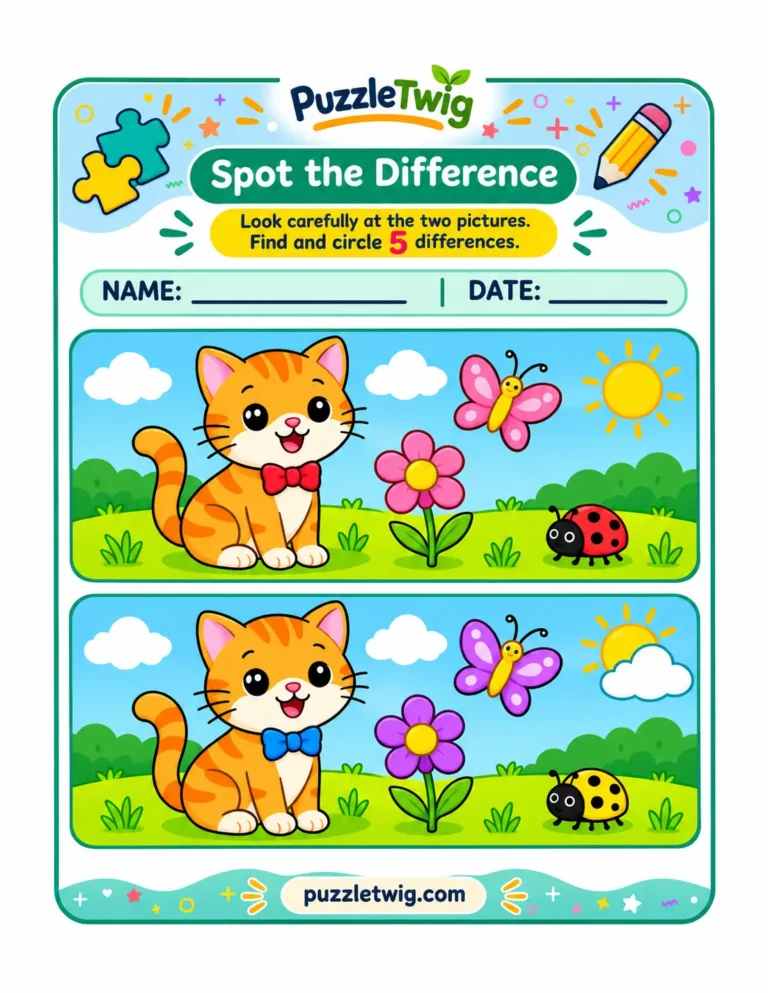
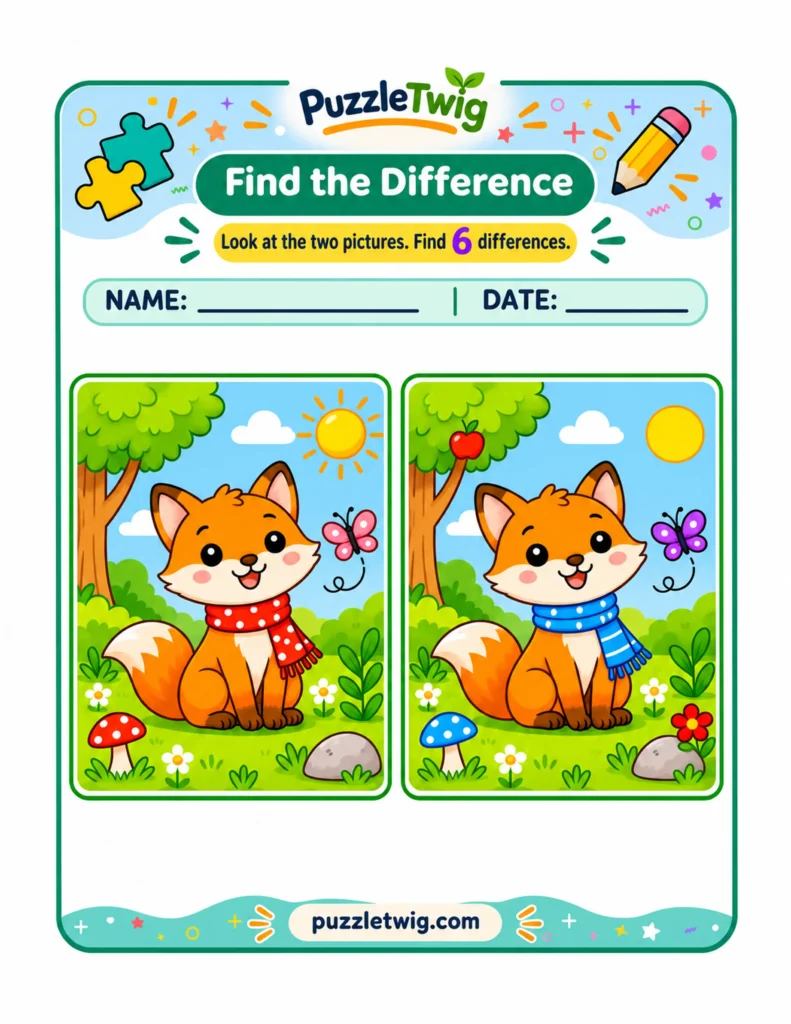
This free fox spot the difference worksheet challenges preschool children ages 3–6 to find 6 differences between two colorful woodland pictures. Both scenes feature an adorable orange fox wearing a scarf, surrounded by a butterfly, sunshine, flowers, and a mushroom. Children can explore these cheerful illustrations while practicing careful observation and attention to detail.
With 6 hidden differences to discover on one printable page, this fox picture puzzle offers a fun, screen-free learning activity for young children. Perfect for preschool classrooms, kindergarten readiness practice, woodland animal themes, or quiet learning time at home, this free printable encourages children to compare pictures, notice small changes, and build confidence in their observation skills.
Free printable activity
Cute Fox – Find 6 Differences
Children compare two colorful fox woodland pictures and find and circle 6 differences between the scenes.
- Ages 3–6
- Visual discrimination
- Easy
- One-page printable
Materials Needed
- Printed fox spot the difference worksheet
- Pencil or crayon
- Flat writing surface
How to Prepare the Activity
Print the one-page worksheet featuring two side-by-side fox woodland scenes. Provide a pencil or crayon and explain that children need to find 6 differences between the pictures.
How to Play — Step by Step
- Write your name and date at the top of the worksheet.
- Look carefully at the fox picture on the left.
- Compare it with the fox picture on the right.
- Search for changes in colors, objects, and small details.
- Circle each difference you discover.
- Continue until you have found all 6 differences, then review your answers.
What Kids Practice
- Visual discrimination
- Attention to detail
- Visual scanning
- Concentration
- Fine motor coordination
Make It Easier
Help children compare one small section of the two pictures at a time, starting with the fox and its scarf. Encourage them to look at matching objects in both scenes before moving to another section.
Add a Challenge
Ask children to find all 6 differences independently without hints. Encourage them to describe each change using complete sentences and explain whether it involves a different color, an added object, or a missing detail.
Helpful Tips for Parents & Teachers
Encourage children to scan the two pictures from top to bottom, comparing the same areas in each scene. Remind them to circle every difference they find so they can keep track of their progress.
Answer Check
If a separate answer key PDF is available, use it to check all 6 differences: the apple in the tree, the sun's rays, the butterfly's color, the fox's scarf color and pattern, the mushroom's color, and the extra red flower beside the rock.
Why Fox Spot the Difference Worksheets Help Preschoolers Learn
Spot the difference activities help preschool children strengthen visual discrimination, concentration, and attention to detail. As children compare the two fox woodland scenes and search for 6 differences, they practice recognizing changes in colors, shapes, patterns, and objects. These observation skills can support early learning activities such as picture matching, sorting, pattern recognition, and identifying similarities and differences.
Finding differences also encourages patience, problem-solving, and independent thinking. Children learn to examine visual information carefully, compare corresponding details, and check their observations before making decisions. Circling the differences adds fine motor practice while giving young learners a clear way to show what they have discovered.
Teacher Tips from the Classroom
- Compare One Section at a Time. Have children examine the fox in both pictures before moving to the tree, butterfly, sunshine, and garden details. Encourage them to focus on one area rather than searching randomly across the page.
- Encourage Descriptive Language. Ask children to explain what looks different between the two scenes. Model simple comparison sentences using words such as same, different, missing, added, colors, and patterns.
- Review All Six Discoveries. After children find the 6 differences, invite them to count their circles and explain their answers. Ask which difference was easiest to notice and which required the most careful observation.
Extend the Fun
- Make Your Own Fox Picture Puzzle. Have children draw two similar woodland pictures and change three small details for a friend or family member to discover.
- Woodland Observation Game. Gather pictures of foxes, trees, butterflies, and flowers, then invite children to compare their colors, shapes, and patterns.
- What Changed Game. Arrange several familiar objects on a table, let children study them, then change or remove one object while their eyes are closed and ask them to identify the difference.
Frequently Asked Questions
What age is this fox spot the difference worksheet suitable for?
This free printable is designed for preschool children ages 3–6. Younger children may need help comparing the pictures, while older preschoolers can try finding all 6 differences independently.
How many differences are included in this fox worksheet?
The worksheet contains 6 differences between two colorful fox woodland scenes. Children compare details such as the fox’s scarf, butterfly, tree, sunshine, mushroom, and flowers to identify the changes.
Can teachers use this fox spot the difference worksheet in preschool classrooms?
Yes. This printable works well for preschool learning centers, woodland animal lessons, independent table activities, small-group visual discrimination practice, and kindergarten readiness activities.
What should I do if my child cannot find all 6 differences?
Encourage your child to compare one section of the pictures at a time, starting with familiar objects such as the fox or butterfly. If needed, give a gentle hint about where to look without revealing the exact difference.